
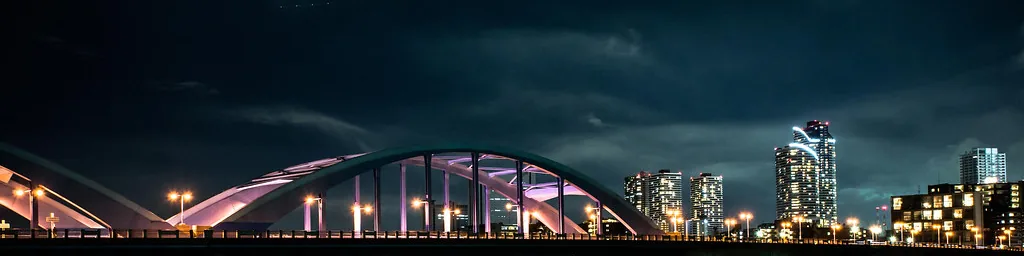
Kawasaki fills the gap between Tokyo and Yokohama, close enough to both that most visitors pass through it without stopping. That is the mistake this page is written against: the city has a temple founded in 1128 that still runs its fire rite every day, a museum of twenty-five farmhouses rescued from all over eastern Japan, a museum of original manga drawings that sells nothing at the door, and a waterfront whose lit factories have become a genre of photography in their own right.
The place has two faces and they are both honest. On one side it is a post town on the old Tokaido road, then an industrial city that built the Keihin industrial belt, then a working-class suburb of two metropolises; the city celebrated its hundredth anniversary in 2024 and rebuilt its city hall in 2023 with an observation floor on top. On the other side it is where Fujiko F. Fujio, the creator of Doraemon, lived for decades, and where a generation of families now brings its children to see the drawings. A temple for warding off evil and a manga museum in one municipal boundary is not an oddity to apologise for: it is the reason to come.
Getting around is the easy part. The Tokaido line runs straight through Kawasaki Station, so Tokyo and Yokohama are short rides away in either direction, and the Keikyu line does the temple side of town with its own airport express from Haneda. The museums and farmhouses in the northern hills sit on the Odakyu and Nambu lines, a different corner of the same city. Nothing on this page needs a car, and one route is built entirely around a booking you make at home.
Choose a useful base
Kawasaki Station and the arcades
The practical answer. The station district is where the city eats, where the underground arcades keep you dry, and where both the temple side and the northern lines connect. Stay here if you want one base for all three routes, and take the train for each of them.
The temple side, towards Daishi
The quieter answer. The blocks around the temple station are the old approach town, close enough to walk to the gate in the morning before the day's visitors arrive. It turns the temple from a stop into the shape of the day.
Noborito and Mukogaoka-yuen
The green answer. The northern stations put the manga museum and the farmhouses within a short walk or a local bus, with the park between them. Best if your booking is an early slot and you would rather not cross the city twice.
Build your days
Kawasaki / Kawasaki Daishi / Kawasaki Station
Kawasaki Daishi: the temple that wards off evil
A temple founded in 1128, a fire rite held every day, an Indian-style hall where drivers have their cars blessed, and a station district that still eats like a post town.
Kawasaki / Noborito / Ikuta Ryokuchi
A manga museum on timed tickets, and twenty-five farmhouses
A morning booked in advance because the museum sells nothing at the door, then an afternoon among twenty-five relocated farmhouses, every one a designated cultural property.
Kawasaki / Kawasui aquarium / The waterfront
The waterfront by day, the factory lights by night
The shortest escalator in the world, an aquarium over the station, then seven islands and sixteen canals of lit plant towers seen from the water.
What to leave out
Do not treat the manga museum as a walk-up. Entry is by date and time, the ticket is bought before you arrive, and the museum itself sells nothing at the door; the official notice is unusually direct about it. Decide the slot first, then build the rest of the day around it, and accept that peak dates sell out well ahead.
The northern hills are a different Kawasaki from the station district, and the two do not mix well in one afternoon. The farmhouses, the manga museum, the Okamoto museum and the park's planetarium all sit inside the same green belt, which is a full day on its own; the waterfront belongs to the other end of the city. Choose the end rather than zig-zagging.
The factory night view is a night view. The bus tours climb to the expressway for the panorama above the plants and the house boats thread the canals so that you look up at them from the water, and both run in the evening as their own outing. Going to the industrial zone in daylight to see the same thing will only show you a working port.
Beyond the three routes here, the city's other set pieces are small and specific: a fox shrine with a hundred and eight stone foxes founded as a branch of the great Inari shrine in Kyoto, a gallery of ukiyo-e prints that changes its display almost every month, and the underground shopping streets that make a wet day workable. None of them needs a plan of its own, but any of them can fill the hour before a train.
A meal that fits
Kawasaki does not have a signature dish, and it is a mistake to invent one for it. What it has is a food culture with two roots: the old post town on the Tokaido, where travellers ate what the road gave them, and the factories, which fed their workers in quantity. The result is a station district full of large portions, fast service and reasonable prices rather than destination restaurants, and a city where eating well is an everyday thing rather than an occasion.
The temple side has its own logic, with the streets between the station and the gate doing the feeding, and the northern park keeps a soba restaurant among the farmhouses. For the rest, follow the arcades: the underground passages under Kawasaki Station connect the shops, the department store and the platforms, and on a wet day they are the whole city.
Read the temple and station route →Kawasaki Station is on the Tokaido line, a short ride from Tokyo and one stop from Yokohama; the same station connects to the Nambu line for the northern museums, while the Keikyu line serves the temple side and carries the airport express from Haneda. The temple's own directions are a change at Keikyu Kawasaki to the Daishi line, one stop, then eight minutes on foot, or a bus from the east exit of JR Kawasaki Station to the same eight-minute walk. The farmhouses are thirteen minutes on foot from the south exit of Mukogaoka-yuen Station, or a short local bus, and the manga museum runs a paid shuttle from Noborito Station on its open days, with no car park at the museum itself.
Sources & useful checks
Official information checked on 13 November 2026. Follow the operator or venue for changes and your travel dates.