
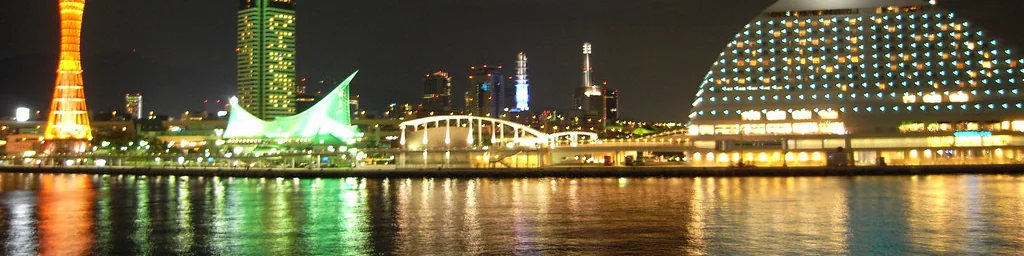
Kobe is a harbour town with the mountains directly behind it, and that is the whole geography of the place: a strip of city pressed between the sea and the Rokko ridge, steep enough that the streets above Sannomiya turn into stairs. The official guide calls it a harbour town where the mountains meet the sea, and the phrase earns its keep on the first afternoon, when you can walk from a waterfront park to a hillside of nineteenth-century houses in twenty minutes.
The city made itself from the port. Kobe opened to foreign trade in 1868, and the settlement that grew up around it left two things behind that still organise a visit: the grid of stone and brick buildings on the flat land, and the western houses on the slope above, built by merchants and consuls who wanted the view. Add a Chinatown that grew with the same trade, a waterfront rebuilt twice over, and a mountain that gives you the city and the bay at once, and you have a place that rewards a full day rather than a stop.
Access is the part that surprises people. The official guide puts Kobe at around twenty minutes by train from Osaka and fifty from Kyoto, and calls the access superb. That makes it the easiest city in this guide to add to an itinerary already built around Kansai, and it also makes it easy to under-plan: a half day gets you a beef lunch and one street. Give it a day, or give it a night and use it as a second base in Kansai.
Choose a useful base
Sannomiya
The transport answer, and the guide's own recommendation for a sightseeing base: four rail operators meet within a few minutes of each other, and the hillside, the Chinatown street and the waterfront are all inside a walk. If you are here for one night and one full day, stay here rather than by the water.
The bay: Motomachi, Meriken Park, Harborland
The view answer. Hotels along this stretch face the water, the port tower and the park are on the doorstep, and the evening walk is the best thing in the city. It costs you ten minutes of walking to the station in the morning, which is nothing.
Arima Onsen
The slow answer. Arima is inside the city limits but over the ridge, thirty minutes from downtown by subway and train, or the same by direct bus. A traditional inn here turns a Kobe stop into a two-night stay, and the town is worth the evening you would otherwise spend in a business hotel.
Build your days
Kobe / Meriken Park / Nankinmachi / Kyukyoryuchi
The harbor and the old quarter: Meriken Park, steam buns and the settlement
The waterfront first, then the Chinatown street for lunch, then the stone grid behind it. The day that explains why Kobe looks the way it does.
Kobe / Shin-Kobe / Nunobiki / Kitano
Shin-Kobe to Kitano: a waterfall walk, western houses and a ropeway
A gorge behind the shinkansen platform, four waterfalls, and the hillside of foreign houses below it. The greenest morning this guide has in a city.
Kobe / Nada-Gogo / Mt. Rokko / Arima Onsen
Nada and Arima: sake cellars, a ropeway over the mountain and golden springs
Brewery museums in the morning, a cable car and a ropeway across the ridge, and a hot spring town at the end. The one day here that ends somewhere else.
What to leave out
Do not treat Kobe as the half day between Osaka and Himeji. The trains make it possible, the city makes it tempting, and it is the most common way to see Kobe badly: one beef lunch, one photograph of the tower, and no time to walk uphill into the part of the city that is actually distinctive.
The three days above are three days. Trying to fit the waterfalls, the foreign houses, the waterfront, the sake district and the hot spring town into one is not ambition, it is arithmetic that does not work: the mountain alone takes an afternoon, and Arima is over the ridge from everything else.
The houses are the other thing to pace. Each one keeps its own hours and its own admission, and some are closed on rotating weekdays, so decide on the day rather than building a route around interiors. The same goes for the tower and the ropeway: both are weather and maintenance dependent, and both are worth checking before you climb.
If a Kobe beef dinner is the reason for the trip, book it rather than walk in: the well-known rooms fill up, and the difference between a plan and a queue is one reservation. The date of the winter illumination also moves each year, so check it before you build a trip around it.
A meal that fits
Kobe beef is a real thing and a defined one: the name only goes to meat from pure-bred Tajima cattle raised in Hyogo, graded four or above with a marbling score of six or above, which is less than a fifth of one per cent of the beef sold in Japan. It is also a style that was invented here in the room, since teppanyaki as the world knows it developed in this city. Order it once, at lunch if you want the meal without the ceremony, and treat the rest of the day as walking.
The cheaper register is just as local. Nankinmachi sells miso-sauce dumplings and steamed buns from counters along one street, and Nada's dry sake was brewed to go with meat like this. There is also a bread culture here that the city is quietly proud of: it has around two hundred bakeries and spends more per head on bread than anywhere else in the country, which is a good excuse for a second breakfast.
Read the harbor and Chinatown route →Kobe is served by Shin-Kobe Station on the Sanyo shinkansen line, which connects it east to Osaka, Kyoto and Tokyo and west to Hiroshima and Kyushu; the official guide puts central Kobe at around 20 minutes by train from Osaka and 50 minutes from Kyoto. Kobe Airport is about 20 minutes from Sannomiya by Port Liner or bus, and the ferry from Kansai International takes about 30 minutes. Check current timetables for the day you travel.
Sources & useful checks
Official information checked on 10 November 2026. Follow the operator or venue for changes and your travel dates.