
Hiroshima sits on a delta, built across the mouths of the Ota river, so the centre is a set of islands and bridges and the water is never far away. It is also the city that an atomic bomb destroyed, and it does not avoid that: the ruin at its centre is held as it stood, the park behind it is a place of mourning and argument, and the museum and the survivors who speak there are the reason many people come. Visitors are welcomed into that quietly, and the city asks only for time rather than reverence.
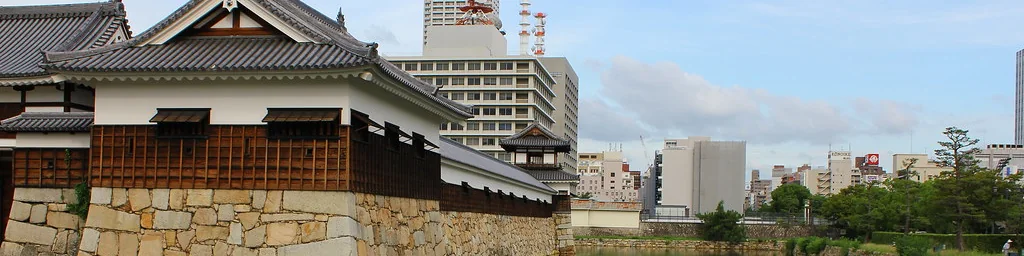
Two World Heritage sites were registered here in the same year, 1996: the dome, and Itsukushima Shrine out on the island of Miyajima. Between them stands the castle that gives the city its symbol, a five-storey tower restored to its original appearance in 1958 while Hiroshima was still rebuilding, which is why the place is nicknamed Carp Castle and why two stone carp sit at the shrine beside it.
Access is what makes it work as an anchor for the west. Hiroshima Station is on the Sanyo shinkansen, about four hours from Tokyo and much less from Osaka or Kyushu, and the airport bus runs into the bus centre in under an hour. Inside the city the trams do the work: the stop for the dome is a minute from the park, and the same network reaches the castle end of town. Miyajima is a train and a ferry away, or a boat from the bridge in the middle of the city.
Choose a useful base
Peace Memorial Park and the centre
The walking answer. The park, the dome, the museum and the shopping blocks around Hondori are within ten minutes of each other, with the tram line running through them. Stay here if the peace sites are the reason for the trip: you get them at the start of the day, before the groups arrive.
The castle and the rivers
The quiet answer. The castle hill, the shrine beside it and the wide riverbanks sit north of the centre, close enough to walk and far enough to be calm at night. The lit tower is the view from the window.
Miyajima, or the mainland side of the strait
The island answer. Most of the island's inns are on the north side of the pier, which puts the shrine and the gate at the start and the end of the day, when the day-trippers have gone. It turns a Hiroshima stop into two nights and one very quiet morning.
Build your days
Hiroshima / Peace Memorial Park / Hiroshima Castle
The dome, the park and the castle that came back
The ruin held as it stood, the park and the museum behind it, a layered lunch, then a tower rebuilt in 1958 and lit up at dusk. The day that explains the city.
Hiroshima / Miyajimaguchi / Itsukushima Shrine
Miyajima: the shrine that stands in the sea
A short train west, a ten-minute ferry and a shrine built over the water, with a 350-metre street of grilled oysters and eel rice behind it.
Hiroshima / Okonomimura / Central arcades
Okonomiyaki, oysters and the middle of the city
A building of okonomiyaki counters, a dry noodle dish the city is said to have started, oysters in season and a river walk after dark.
What to leave out
Do not bolt Miyajima onto the end of a city day. The train and the ferry are short, but the island is decided by the tide: at high water the gate seems to float, at low water you walk out to it across the sand, and you cannot choose which of those you get without looking at a table first. Give it a day, check the tide times and the last ferry back, and do not arrive at four in the afternoon.
The prefecture is much bigger than the city. The Shimanami Kaido runs some sixty kilometres across islands to Ehime, Onomichi and Tomonoura are old port towns on the coast, Okunoshima is the small island known for its rabbits, and Sandankyo is a gorge inland. All of them are good days and none of them is a city day: take one only if Hiroshima is getting two nights or more.
Give the peace sites a morning rather than an hour, and let the museum carry the numbers. On 6 August the park holds its memorial ceremony and lanterns are floated on the river in the evening; visitors can take part if they register, the park is crowded and parts of it are closed, so check the programme before planning anything else that day.
The castle keep closed on 22 March 2026 after seismic checks found the 1958 concrete reconstruction unsafe, and its exhibits have moved to the new Sannomaru history museum by the moat. The grounds, the restored Ninomaru buildings and the keep's exterior are still open, and they are still worth the walk.
A meal that fits
Hiroshima's okonomiyaki is built rather than mixed. A thin crepe goes down on the griddle, then a heap of cabbage and bean sprouts, pork, and noodles, and the whole thing is turned once and finished with an egg pressed on top; the sauce is sweet and the noodles are the difference from the Osaka version, with soba or udon as your choice when you order. Okonomimura, a building of counters in the centre, is the simplest place to start: pick a counter that looks busy, sit where there is space, and watch it being assembled.
The prefecture farms more oysters than anywhere else in the country, and they are at their best in winter: raw, grilled, fried, or served by the plate in the shellfish sheds along the coast. On Miyajima the standard lunch is anago meshi, conger eel grilled and laid over rice in a lacquered box. The city is also said to have started the dry version of tantanmen, noodles dressed with sesame and chilli instead of served in broth, and east of the city Saijo calls itself the sake capital, with a street of breweries to prove it.
Read the okonomiyaki and oyster route →Hiroshima Station is on the Sanyo shinkansen: Tokyo is about four hours away, Osaka and Fukuoka much closer, and train types differ, so check the timetable for the day you travel. The airport limousine bus reaches the bus centre in the middle of the city in about fifty-five minutes; the airport has no rail link, and the arrival guide compares the bus with a taxi. Trams cover the centre and the dome stop is a minute from the park. For Miyajima, the official directions are about six minutes on foot from JR Miyajimaguchi Station to the pier, about ten minutes by ferry, and about fifteen minutes on foot from the pier to the shrine; the other way across is the World Heritage Route boat from the Motoyasu Bridge, about forty-five minutes on the water.
Sources & useful checks
Official information checked on 12 November 2026. Follow the operator or venue for changes and your travel dates.