
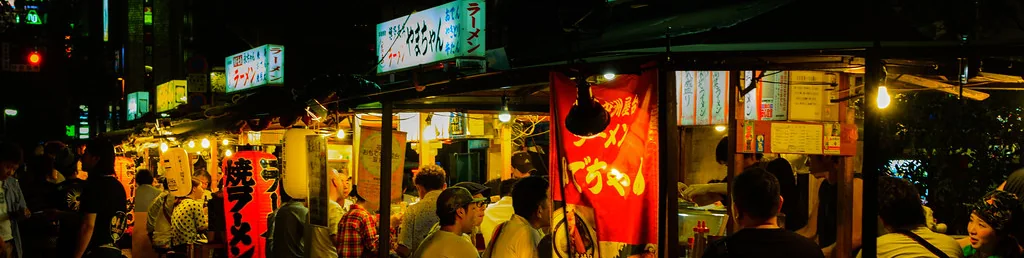
Fukuoka sits at the western end of the main island, and on this site it is the one city that reads better as a beginning or an end than as a stop in the middle. The shinkansen from Tokyo takes about five hours and the flight a little over one, so a first trip that reaches Kyushu usually starts or finishes here rather than passing through.
The city also carries two names in ordinary use: it is Fukuoka, and its main station and oldest district are Hakata. They are the same place, and the split is practical rather than confusing — the map simply has two centres, the station on the east side of the river and the shops and stalls of Tenjin and Nakasu on the west, ten minutes apart by subway.
Choose a useful base
Hakata
The station district, and the one to pick if you are arriving late or leaving early. The shinkansen, JR lines and subway converge here, the airport is two subway stops away, and the dining floors inside JR Hakata City are attached to the concourse. Sumiyoshi Shrine and Rakusui-en garden are about ten minutes on foot, which is the balance this area offers: transport on one side, quiet streets on the other.
Tenjin / Yakuin
Consider this if the evenings matter. Tenjin is where the city eats and shops, with the underground mall running beneath the main street and the smaller neighborhoods of Kego, Daimyo and Imaizumi behind it. The stalls gather here and in Nakasu, which is one bridge away, so the last hour of the day needs no planning.
Ohori / Ropponmatsu
The slowest of the three. A lake with a path around it, a Japanese garden inside the park, the city art museum on its edge and the castle ruins next door. Fewer hotels than the station side and a quieter evening, which is the trade you are making.
Build your days
Fukuoka / Hakata / Canal City / Tenjin or Nakasu
Hakata old town and the yatai: shrines, arcades and a stall dinner
The old town first, a mall that doubles as a river walk, then a stall dinner wherever the lights are. The evening half is the part you cannot schedule.
Fukuoka / Ohori Park / Fukuoka Art Museum / Maizuru Park
Ohori Park and the castle ruins: a lake loop and the museum
A lake you can walk around, a garden inside it and a museum at the edge. The castle next door is walls and grass, not a keep.
Fukuoka / Tenjin / Daimyo / Imaizumi / Nakasu
Tenjin to Nakasu: the food heart, the arcades and the river
An underground street, three shopping neighborhoods and a river crossing at dusk. The eating is the itinerary here, not a break from it.
What to leave out
Do not plan the stalls. They gather in Tenjin, Nakasu and Nagahama as the light goes, and their evenings depend on weather and on the stallholder's own calendar. An evening built around one particular stall is an evening that can fail; an evening that walks until a counter has a free seat is the one that works.
The castle is the other thing to plan differently. What survives at Maizuru Park is stone: walls, gate foundations and the lines of the moats. There is no keep to climb and no reconstructed tower, so treat it as a walk through the ground rather than a visit to a building, and it takes an hour rather than a morning.
A meal that fits
Fukuoka is a city where you eat one thing properly rather than five things quickly. The three names to know are tonkotsu ramen, a pork-bone broth that is the local benchmark; motsunabe, an offal hotpot finished with noodles; and the stalls themselves, where the same city eats ramen, oden, gyoza and tempura standing at a counter. Gomasaba, mackerel under a sesame sauce, is the dish locals order when they are not in the mood for any of it.
If you have one dinner only, spend it at a stall and keep the order short. If you would rather sit down for two hours, book the hotpot instead and treat the stalls as a walk afterwards.
Read the Tenjin and Nakasu route →By shinkansen, Hakata is about five hours from Tokyo and about two and a half from Osaka. Fukuoka Airport is the closest city airport in this guide: the subway reaches Hakata in a few minutes and Tenjin in about ten. Check current timetables for the day you travel.
Sources & useful checks
Official information checked on 6 November 2026. Follow the operator or venue for changes and your travel dates.